· 7 min read · by Wowpilot Team
How to Verify a Business Before Working With Them
Before signing a contract or sending money, take a closer look at the company behind the offer. Here's how to verify a business, research its reputation, and reduce the risk of a bad partnership.
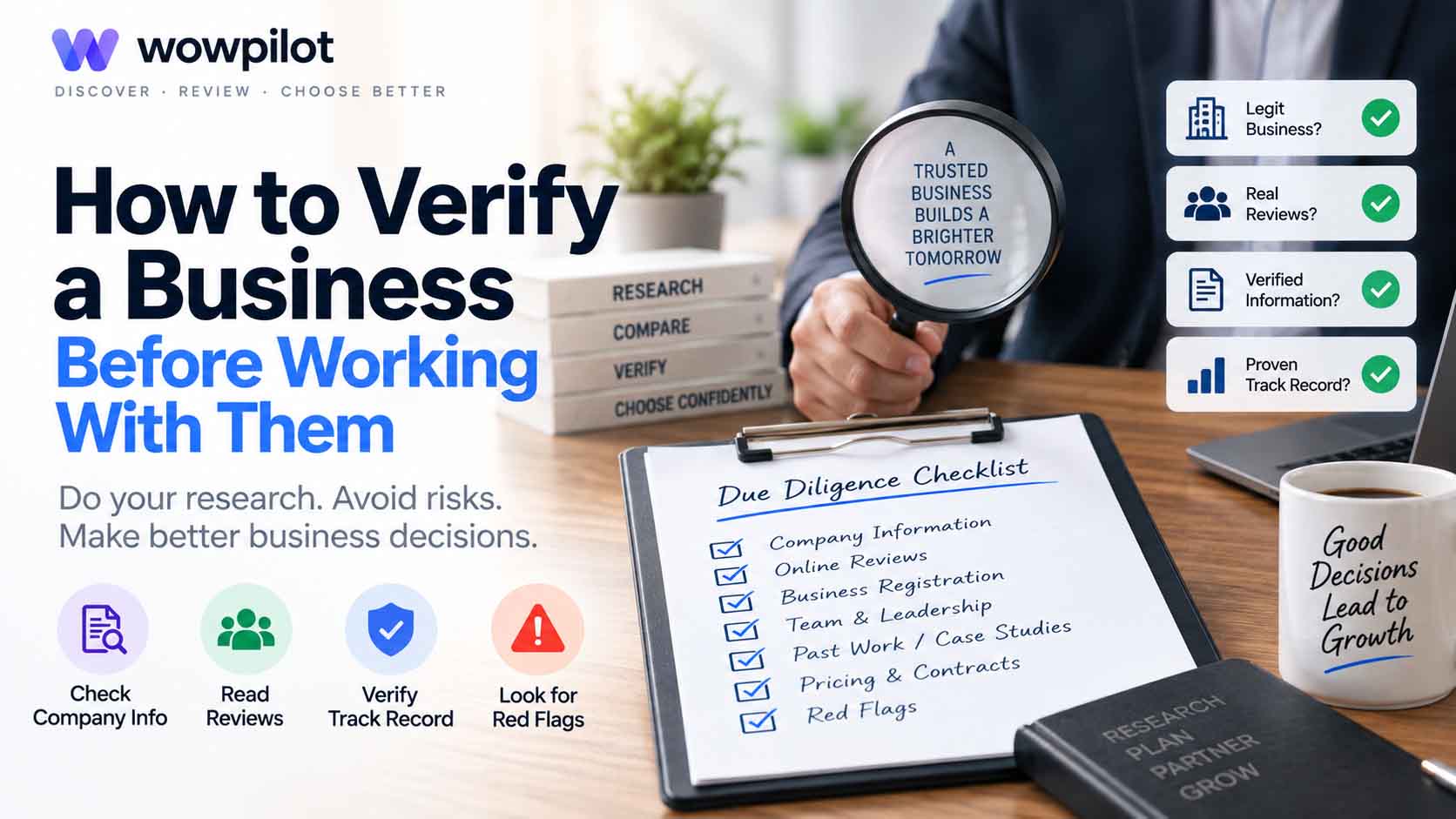
Choosing a business partner, agency, contractor, consultant, supplier, or service provider is fundamentally different from buying a product online.
A product can arrive late and still be replaced.
A poor business decision can cost months of work, thousands of dollars, sensitive information, or a relationship with your own customers.
That's why business verification matters.
The good news is that you don't need access to private databases or sophisticated investigative tools to perform a meaningful check.
You simply need to look at the business from several different angles.
Start With the Company's Identity
Before evaluating what a company sells, establish who is actually behind it.
Look for the company's official name, website, location, contact information, and any relevant registration details available in its jurisdiction.
Then compare that information across different sources.
Does the company use the same name everywhere?
Does the address appear consistently?
Does the website domain match the company's stated identity?
Are the people representing the company identifiable?
A legitimate business doesn't necessarily need a huge online presence, but its basic identity should generally be understandable.
If you can't determine who you're dealing with, that's an important reason to pause.
Search for Independent Information
Never rely exclusively on information provided by the company itself.
A company's website is designed to present its best side. That's normal. Every business does this.
Your job is to find information that exists outside that controlled environment.
Search for the company name alongside terms such as:
-
Reviews
-
Complaints
-
Customer experiences
-
Case studies
-
Industry discussions
-
News
-
Partnerships
-
Awards
Look across several sources rather than relying on the first result you find.
Business review platforms and independent directories can be especially useful because they can reveal patterns that aren't visible on a company's own website.
Look at the Reviews — Not Just the Rating
A 4.8-star rating tells you something.
It doesn't tell you everything.
Read the reviews themselves.
Are they detailed?
Do customers mention specific projects?
Are reviews spread across a reasonable period?
Do customers describe both positive and negative experiences?
Most importantly, look at how the company responds.
A business doesn't need to have zero negative reviews to be trustworthy. In fact, an established company serving many customers will inevitably encounter disagreements.
The response can be more informative.
Does the company attempt to resolve the issue?
Does it provide a professional explanation?
Does it invite the customer to continue the conversation privately?
Or does every criticism result in an aggressive response?
Patterns matter more than isolated comments.
Verify the People You're Dealing With
When you're making a significant business decision, you should know who you're communicating with.
Look at the people listed on the company's website or professional profiles.
Do their roles make sense?
Can their professional history be independently verified?
Does the person contacting you actually appear to work for the organization?
This becomes especially important when someone approaches you unexpectedly claiming to represent a recognizable company.
Don't assume that a familiar logo or company name proves the person is legitimate.
When in doubt, contact the company through independently sourced contact information and ask whether the person works there.
Examine the Company's Track Record
Experience isn't everything, but history provides context.
Look for evidence of previous work.
Depending on the business, this might include:
-
Client case studies
-
Portfolio projects
-
Customer testimonials
-
Product releases
-
Industry partnerships
-
Public announcements
-
Media coverage
-
Professional profiles
A company claiming to have completed hundreds of projects should ideally have some evidence of that activity.
Again, this isn't about expecting every small business to have extensive documentation.
It's about whether the company's claims appear proportionate to the evidence available.
Understand the Commercial Relationship
Before signing anything, make sure you understand exactly what you're buying.
Ask:
What is included?
What isn't included?
What are the delivery timelines?
Who owns the final work?
What happens if the relationship ends?
How are disputes handled?
What are the cancellation terms?
Are there recurring fees?
These questions may feel tedious when you're excited about a potential partnership.
They're much less tedious than discovering six months later that both parties had completely different interpretations of the agreement.
Look for Transparent Pricing
Pricing doesn't have to be cheap to be legitimate.
In fact, unusually low pricing can sometimes create more questions than high pricing.
Instead, look for transparency.
Does the business clearly explain how it charges?
Are there setup fees?
Are there recurring costs?
Are there minimum commitments?
Are important services charged separately?
If a company refuses to explain its pricing structure until after you've signed a contract, proceed carefully.
A professional business should generally be able to explain its commercial model.
Check the Company's Digital Footprint
A company's digital presence can reveal useful clues.
Look at its website history, social profiles, professional listings, customer discussions, and industry presence.
You may discover that the business has operated for years and has a consistent history.
You may also discover that the company's online identity appeared only recently despite claims of a much longer operating history.
Neither situation automatically proves anything.
The point is to identify discrepancies worth investigating.
Don't Confuse Professional Design With Trust
A sophisticated website can cost very little to create.
That means design quality alone isn't evidence of business quality.
A legitimate company can have an outdated website.
An unreliable company can have a beautiful one.
Think of website design as presentation rather than verification.
Look underneath the presentation.
Who runs the company?
Who are its customers?
What do independent sources say?
What evidence exists of its work?
How does it communicate?
How does it handle criticism?
Those questions provide much stronger signals.
Use Multiple Sources
No single source can tell you everything about a company.
A business profile may provide customer reviews.
A professional network may provide information about the team.
The company's website may explain its services.
Industry publications may provide historical context.
Customer discussions may reveal practical experiences.
Together, these sources create a much more complete picture.
This is also why business discovery and review platforms can be useful during the research process. WowPilot, for example, gives users another place to discover businesses and examine information around them rather than relying entirely on a company's own marketing materials.
Think of it as another piece of evidence, not the final verdict.
Know When to Walk Away
Verification isn't just about finding reasons to proceed.
Sometimes the research gives you reasons to stop.
Be cautious when multiple serious inconsistencies appear:
-
The company's identity is difficult to verify.
-
Contact information repeatedly changes.
-
Claims can't be supported.
-
Reviews show a consistent pattern of unresolved problems.
-
Pricing or contracts are deliberately unclear.
-
The business pressures you to make an immediate payment.
-
Representatives refuse reasonable verification requests.
One small issue doesn't necessarily mean anything.
Several unrelated warning signs appearing together deserve attention.
Verification Is About Reducing Uncertainty
You can never eliminate all risk from a business relationship.
Even established companies can fail to deliver.
People can change.
Markets can change.
Projects can go wrong.
The objective isn't perfect certainty.
It's informed confidence.
Before working with a business, take the time to understand who they are, what they have done, what customers say about them, and exactly what you're agreeing to.
A few hours of research can be insignificant compared with the cost of a bad business relationship.
And in an increasingly digital economy, knowing how to verify a business is becoming less of a precaution and more of a basic business skill.