· 7 Min. Lesezeit · von Wowpilot Team
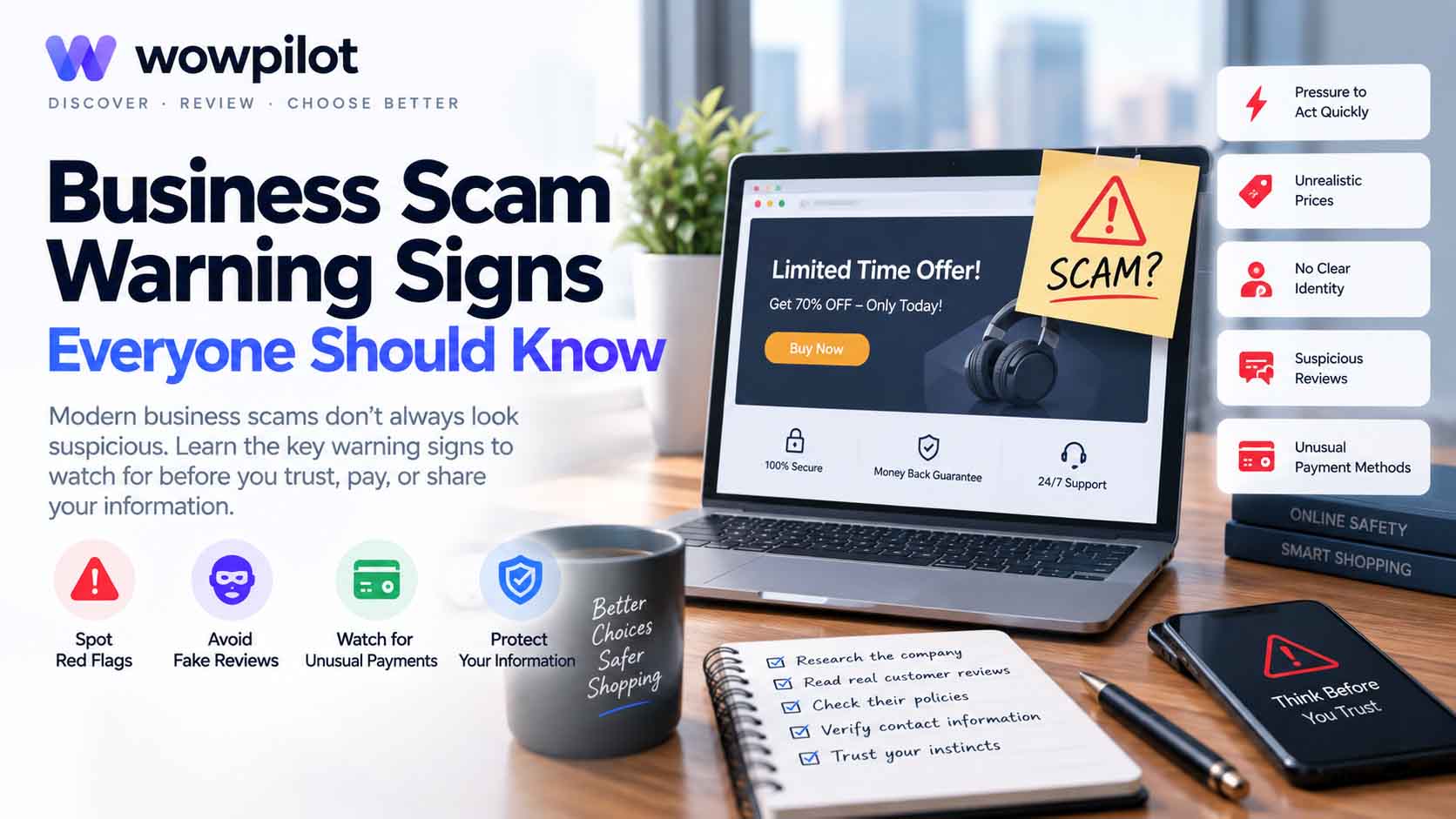
Business Scam Warning Signs Everyone Should Know
Modern business scams don't always look suspicious. Learn the warning signs to watch for, from high-pressure tactics and unrealistic promises to questionable reviews, payments, and business information.
Most people imagine a scam as something obvious.
A suspicious email.
A strange website.
A message promising an impossible fortune.
But modern business scams don't always look like scams.
Some arrive with professional branding, convincing websites, polished presentations, realistic contracts, and people who sound like experienced professionals.
That's what makes them difficult.
The goal isn't to become suspicious of every unfamiliar company. It's to recognize patterns that deserve a closer look before money, information, or trust changes hands.
Here are some of the most important warning signs.
1. You're Being Pressured to Decide Immediately
Urgency is one of the oldest persuasion techniques, and it remains effective.
"Pay today."
"This offer expires tonight."
"There are only two spots left."
"Sign the contract within the next hour."
Sometimes genuine businesses really do have deadlines.
But when pressure replaces reasonable discussion, take a step back.
A legitimate business opportunity should generally survive a few hours of due diligence.
If someone becomes hostile simply because you want time to verify their company, that's information worth considering.
2. The Company Is Difficult to Identify
One of the simplest checks is also one of the most useful:
Who exactly are you dealing with?
If a company has no clear business name, address, contact information, leadership information, or independent presence online, investigate further.
This doesn't mean every legitimate freelancer or small business needs a large corporate footprint.
It means you should be able to establish enough information to understand who will receive your money and what organization, if any, stands behind the transaction.
3. The Claims Sound Too Good to Be True
Guaranteed results should always receive additional scrutiny.
This is particularly relevant in industries where outcomes naturally vary.
Examples include:
-
Guaranteed investment returns
-
Guaranteed rankings
-
Guaranteed business growth
-
Guaranteed employment
-
Guaranteed sales
-
Guaranteed approval
-
Guaranteed results without conditions
Real businesses can offer strong services without promising outcomes they don't control.
When someone guarantees an extraordinary result with little explanation of the risks or conditions, ask how the guarantee actually works.
4. Reviews Look Suspiciously Perfect
A perfect reputation sounds attractive.
But real customers are complicated.
Even excellent businesses occasionally receive a complaint, misunderstanding, or less-than-perfect experience.
That's why reviews should be examined rather than simply counted.
Look for detailed experiences rather than repetitive one-line praise.
Check whether reviewers appear to have genuine histories.
Look at when reviews were published.
And examine the company's responses to criticism.
A high rating can be meaningful, but the story behind the rating is usually more informative.
5. The Business Has Almost No Independent Footprint
A company doesn't need to be famous to be legitimate.
A new business can have very little history.
But if a company claims to have been operating for many years, serving major customers, or completing hundreds of projects while leaving almost no independent evidence behind, investigate the discrepancy.
Search beyond the company's own website.
Look for customer experiences, professional profiles, business directories, industry mentions, and other independent references.
You're not looking for popularity.
You're looking for consistency.
6. Payment Is Being Requested in an Unusual Way
Payment methods matter.
Be cautious when an unfamiliar business insists on methods that offer limited protection or are difficult to reverse.
Requests involving gift cards, direct transfers to personal accounts, cryptocurrency, or other unusual payment arrangements deserve additional scrutiny when they don't make sense for the transaction.
Ask why the payment method is necessary.
A reasonable business should generally be able to explain its payment process clearly.
7. Important Information Keeps Changing
Small inconsistencies can be revealing.
Maybe the company's website lists one address while its contract lists another.
Perhaps the person contacting you uses a different company name.
Maybe the refund policy refers to a completely different business.
One discrepancy can be a simple administrative mistake.
Several unexplained discrepancies are different.
When information doesn't line up, don't fill in the gaps yourself. Ask questions.
8. You're Asked for Sensitive Information Too Early
Not every business needs access to everything.
Be cautious if a company asks for sensitive personal, financial, or account information before you've established why it needs that information.
Ask:
Why do you need this?
How will it be used?
Who will have access to it?
How long will it be retained?
A legitimate business should be able to explain the purpose of its data requests.
9. The Contract Is Vague Where It Matters
A long contract isn't necessarily a good contract.
Pay attention to the important parts.
What exactly will be delivered?
When will it be delivered?
How much will you pay?
Are there recurring charges?
How can either party terminate the agreement?
Who owns the work?
What happens if something goes wrong?
If the business is reluctant to put important promises in writing, treat that as a warning sign.
Verbal assurances are difficult to rely on later.
10. The Company Avoids Specific Questions
Pay attention to how a business answers reasonable questions.
You might ask for references.
You might ask for clarification about a fee.
You might ask who owns the company.
You might ask for details about a previous project.
A legitimate business doesn't need to answer every question exactly as you'd like, but it should generally be capable of providing a coherent explanation.
Repeatedly changing the subject, becoming aggressive, or refusing basic questions can be informative.
11. The Website Looks Professional — But Nothing Else Does
This deserves special attention because website design can create a false sense of credibility.
A sophisticated website is relatively easy to produce.
Look beyond it.
Does the company have a consistent business identity?
Are its social accounts authentic?
Do customers discuss it?
Are the people behind the company identifiable?
Can its claims be independently checked?
Think of the website as the beginning of your research, not the conclusion.
12. The Business Wants Trust Before Providing Evidence
Perhaps the most important warning sign is psychological.
You shouldn't have to trust someone instead of verifying them.
Good businesses can provide evidence.
References.
Contracts.
Business information.
Customer experiences.
Examples of previous work.
Clear policies.
Transparent communication.
The stronger the evidence, the less you need to rely on promises.
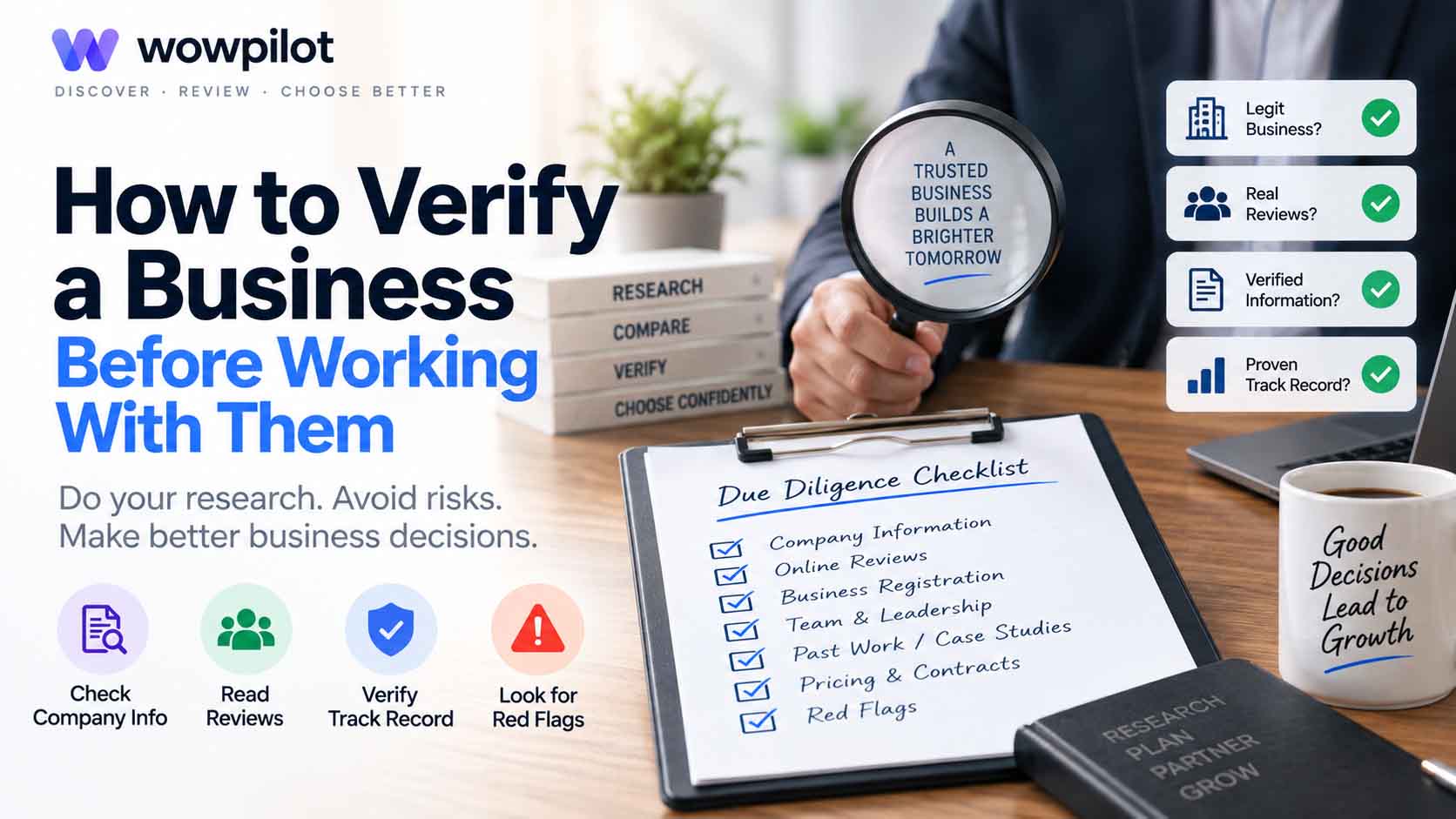
How to Research a Business Properly
When several warning signs appear, slow the process down.
Search for the company's name independently.
Check business directories and review platforms.
Read both positive and negative customer experiences.
Look for professional profiles.
Verify contact information.
Compare the company's claims with independent evidence.
If you're making a significant purchase, consider contacting the business through independently sourced information rather than simply replying to an unexpected message.
Platforms such as WowPilot can also provide another source of business information and customer feedback when you're researching a company.
The important principle is to compare sources rather than treating any individual website or rating as absolute proof.
Don't Let One Red Flag Make the Decision for You
It's important to keep perspective.
A new website isn't automatically a scam.
A negative review doesn't automatically make a company bad.
An unusual payment method isn't necessarily fraudulent.
An outdated website doesn't mean a business is unreliable.
Context matters.
The strongest warning signs usually appear as patterns, not isolated details.
One unusual characteristic may have an innocent explanation.
Five unrelated inconsistencies deserve a much closer look.
The Best Defense Is Time
Many scams work because they create pressure.
The faster you act, the less time you have to investigate.
That's why one of the simplest defenses is also one of the most effective:
Slow down.
Research the company.
Read the contract.
Check independent reviews.
Ask questions.
Verify claims.
Understand the payment process.
And if something doesn't make sense, don't feel obligated to proceed simply because someone is pressuring you.
Trust shouldn't be based on how convincing someone sounds.
It should be supported by evidence.
In a world where almost anyone can create a professional-looking website and a convincing online identity, knowing how to recognize warning signs is an increasingly valuable skill.
The goal isn't to avoid every new business.
It's to make sure that when you decide to trust one, you've done enough research to understand why.