· 5 min de lectura · por Wowpilot Team
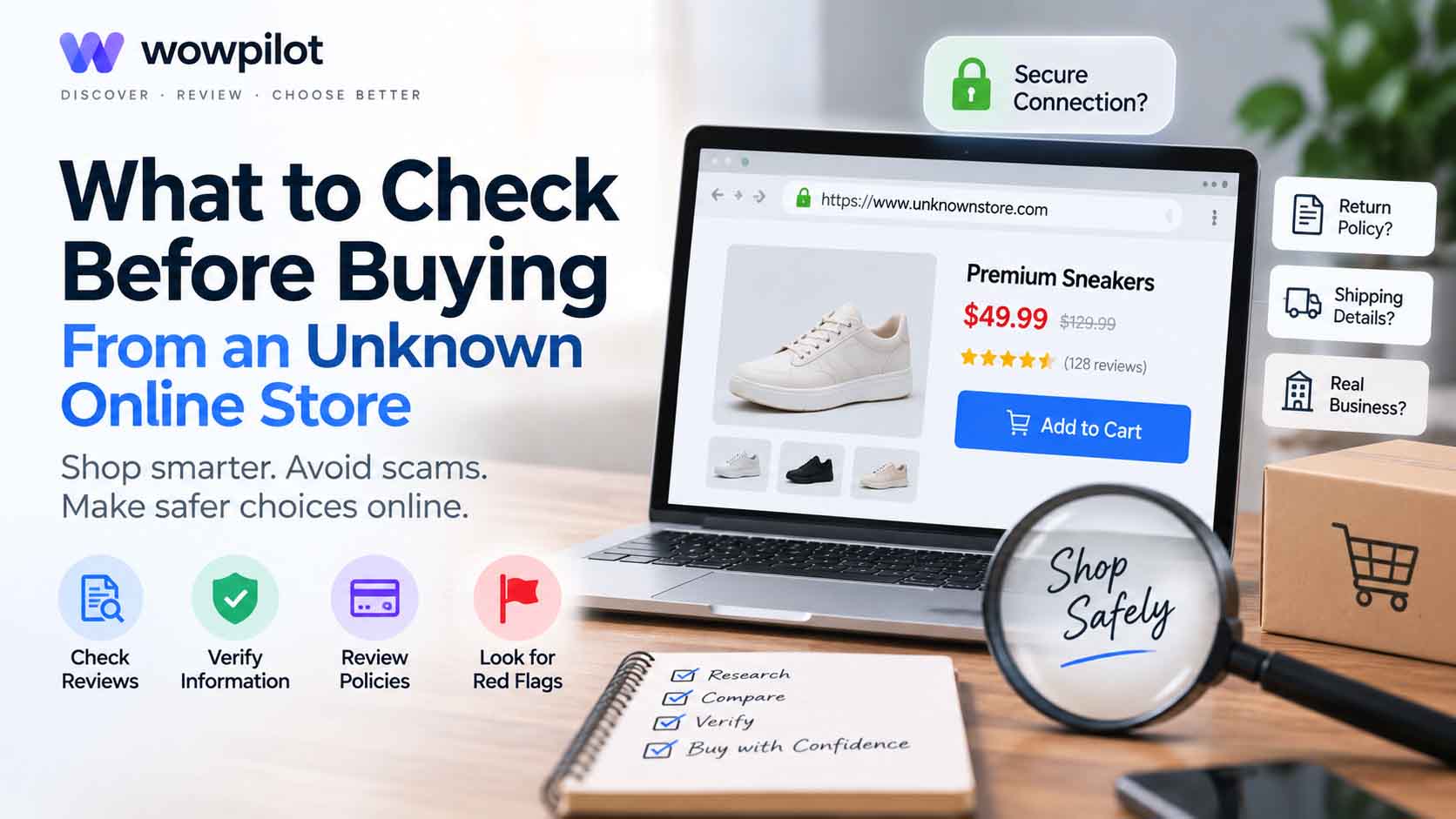
What to Check Before Buying From an Unknown Online Store
Thinking about buying from a store you've never heard of? Learn how to research an unfamiliar online business, evaluate reviews, check policies, and spot potential warning signs before you pay.
What to Check Before Buying From an Unknown Online Store
Finding a new online store can feel like discovering a great deal before everyone else does.
Maybe the prices are better than the major retailers. Maybe the product you've been searching for is finally in stock. Maybe the website looks polished, has professional photography, and is offering a discount that seems difficult to resist.
But an unfamiliar online store deserves a little investigation before you enter your payment details.
That doesn't mean every unknown store is suspicious. Many legitimate businesses are small, new, or simply haven't built widespread recognition yet. The challenge is separating a promising independent business from a website that may not be what it appears to be.
Fortunately, you don't need to be an investigator to do this.
A few checks can reveal a surprising amount about a business before you buy.
Start With the Business, Not the Product
The first mistake shoppers often make is looking only at the product.
Instead, look at the company selling it.
Search for the business name independently of the website. Look for its business profile, social presence, customer reviews, company information, and mentions elsewhere online.
A legitimate business should generally leave some kind of footprint.
That footprint doesn't need to be enormous. A small business may have only a modest number of reviews or a relatively new social media presence.
What matters is whether the information you find is consistent.
Does the business name match across platforms?
Does the location make sense?
Does the website use the same company information?
Are customers actually discussing their experiences?
The more pieces line up, the easier it becomes to understand who you're dealing with.
Check the Website Carefully
A professional-looking website is useful, but appearance alone shouldn't establish trust.
Look for basic business information such as:
-
A real business name
-
Contact information
-
Customer support details
-
Shipping information
-
Returns and refunds
-
Terms and conditions
-
Privacy information
-
A physical address where appropriate
Pay particular attention to the return policy.
A store can have beautiful product pages and competitive prices while making returns extremely difficult.
Check how long you have to return an item, who pays return shipping, whether refunds are issued to the original payment method, and whether certain products are excluded.
Also look for inconsistencies. A business claiming to be based in one country while its policies refer to another can warrant additional investigation.
Look Beyond Reviews on the Store's Own Website
Customer reviews are valuable, but reviews displayed exclusively on the business's own website should not be your only source.
Look for independent reviews.
Search the company name alongside terms such as "reviews," "complaints," or the name of the product you are considering.
Independent review platforms, business directories, forums, and social networks can provide a broader picture.
Don't automatically trust a business because it has hundreds of five-star reviews.
Instead, look for patterns.
Do customers describe specific experiences?
Do different reviewers mention similar strengths or problems?
Does the company respond professionally when someone reports a problem?
A thoughtful negative review isn't necessarily a reason to walk away. In some cases, the way a company handles criticism tells you more than a collection of perfect ratings.
Investigate the Domain and Business History
A website that appears established may actually be very new.
That doesn't automatically mean it's unsafe. New businesses have to start somewhere.
But the age and history of a website can provide useful context.
If a store claims to have been operating for ten years but appears to have only recently established its online presence, you may want to understand why.
Likewise, search for older references to the company. Previous names, addresses, social accounts, or customer discussions can reveal how the business has evolved.
The objective isn't to find a reason to distrust every new company.
It's to make sure the story the website tells matches the evidence you can independently find.
Be Careful With Prices That Seem Impossible
Price is one of the strongest psychological triggers in online shopping.
An unfamiliar store offering a product for 10% less than major competitors may simply have lower overhead.
A store offering the same product for 70% less deserves more scrutiny.
Extreme discounts can sometimes indicate counterfeit products, misleading listings, bait-and-switch tactics, or other problems.
Compare prices across several established retailers.
Also check whether the advertised price is actually the final price. Shipping, taxes, mandatory subscriptions, or additional charges can sometimes appear only later in the checkout process.
A genuine bargain should still make sense when you understand the entire transaction.
Examine the Payment Options
Pay attention to how the store wants you to pay.
Established payment providers can provide additional layers of protection depending on the transaction and your location.
Be particularly cautious if an unfamiliar store insists on unusual payment methods, direct transfers, cryptocurrency, gift cards, or other methods that may provide limited avenues for recovering money.
Before paying, make sure the checkout page is using a secure connection and that the payment information is being entered into the expected domain.
Also remember that a padlock icon alone does not prove a website is legitimate. Encryption protects the con